Call for proposals
Research on Educational Innovations: Evidence, Practice, and Future Directions
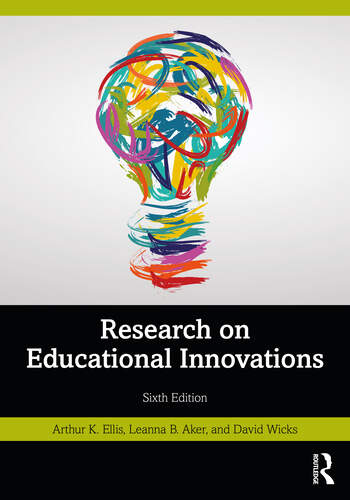
Arthur K. Ellis, Leanna B. Aker, and David Wicks, authors of Research on Educational Innovations (6th edition) , invite researchers and educators worldwide to submit proposals for papers to be presented at the 2026 International Online Symposium on Educational Innovations. Authors of accepted proposals will prepare full papers examining an educational innovation through its theoretical foundations, research evidence, and implications for practice. This small, two-day online symposium is designed to build a learning community in which participants share their work, exchange constructive feedback, and refine their ideas. Participants will read one another’s papers in advance and contribute throughout both sessions, learning with and from colleagues across educational and cultural contexts.
Online via Zoom | Up to 18 papers | No symposium fee
Dates and times
| Location and time zone | Dates in December 2026 | Time each day |
|---|---|---|
| China (UTC+8) | December 11–12 | 8:00 a.m.–12:00 p.m. |
| Jakarta (UTC+7) | December 11–12 | 7:00–11:00 a.m. |
| Seattle (PST, UTC−8) | December 10–11 | 4:00–8:00 p.m. |
These are the same two symposium sessions, shown in different time zones.
Proposal deadline: November 1, 2026, at 11:59 p.m. Pacific Time (PST, UTC−8). This deadline applies to all authors, regardless of location.
Submit a proposal through the online form (opens in a new tab)
What proposals should examine
Select an established, emerging, or locally developed innovation at any educational level. Define it, trace its development, evaluate the evidence, and consider implementation, culture, equity, and future directions. Papers should critically examine an innovation, not promote a product or summarize a trend uncritically.
A shared research framework
Use the following three levels to organize your examination of the innovation and its research base.
Level I: Theory and foundational research
What conceptual, psychological, sociological, philosophical, or disciplinary foundations explain why the innovation might work?
Level II: Empirical research and pilots
What happens when the innovation is studied in educational settings? What outcomes are examined, for whom, and under what conditions?
Level III: Implementation and evaluation at scale
What happens when the innovation is adopted more widely? What does the evidence show about effectiveness, context, equity, and sustainability?
Use research syntheses where relevant, while distinguishing evidence from small studies from evidence of wider implementation. State plainly where evidence is limited, mixed, or contested.
Plan your submission with two free chapters
Routledge offers two free sample chapters from Research on Educational Innovations (6th edition) to help prospective authors plan their submissions.
Chapter 7, “The Research Says: Three Levels of Educational Research,” introduces the shared research framework.
Chapter 8, “Collaborative and Cooperative Learning,” provides an example of its application, linking history and theory with research and implementation considerations.
Access the two free chapters on Routledge’s website
Complete the form on Routledge’s page to download the chapters. This form is for chapter access only and is separate from the symposium proposal submission form.
How to submit a proposal
Submit your proposal through the online Qualtrics form linked above on this page. All primary author information and proposal content must be entered directly into the form. You will not upload a Word document, PDF, or separate author title page at the proposal stage.
1. Prepare and save your information before opening the form
Prepare and save all of your submission information in a separate document, such as a Word document, before beginning the form. Proofread your responses and check your abstract’s word count. You will copy and paste your prepared text into the appropriate fields and select the relevant options in the form.
Keep this document for your records and as a backup in case your internet connection is interrupted. The document itself will not be submitted.
2. Have your primary author information ready
You will need your family name, given name(s), institution or organization, country/region, email address, and position or role. Provide an email address you check regularly.
Individual and co-authored proposals are welcome. Only the primary author should complete the submission form. The primary author will be the sole presenter if the proposal is accepted. Any co-author information will be collected later for accepted proposals.
3. Prepare your proposal content
- Presentation title: A clear, concise title identifying the educational innovation or focus of your proposal (Maximum 15 words).
- Proposal abstract: An English-language abstract 250-300 words, addressing the five elements below.
- Three to five keywords: Terms describing your proposal, separated by commas.
- Educational Innovation: The educational innovation area relevant to your proposal.
- Key references: Up to five references, entered separately from the abstract. References do not count toward the 300-word abstract limit.
Keep author names and affiliations out of the presentation title and abstract. Enter identifying information only in the primary author section of the form.
Your proposal abstract should address the following five elements:
- Innovation and purpose: Define the innovation, the educational problem or opportunity it addresses, and its relevance.
- Origins and theory: Identify its major historical roots, key contributors, and principal theoretical rationale.
- Three levels of evidence: Summarize what is known at Levels I, II, and III, including important limitations or disagreement.
- Implementation and context: Identify conditions involving fidelity, feasibility, culture, equity, resources, or educator preparation.
- Future direction: State the central unresolved question, emerging opportunity, or responsible next step.
4. Complete the confirmations and submit
Each person may be included as an author on only one proposal. This applies to both primary authors and co-authors. The primary author is responsible for confirming that the proposal complies with this requirement.
The form will ask the primary author to confirm their commitment, if accepted, to reading the other papers in advance, presenting live online, and participating in both four-hour sessions through discussion and constructive feedback. This is a small, community-building event in which participants learn from and contribute to one another’s work.
Open the form, copy and paste your prepared text into the corresponding fields, complete the selections and confirmations, and review all entries carefully before completing the final submission step. Retain your separate saved document after submitting.
Submit a proposal through the online form (opens in a new tab)
Submit by November 1, 2026, at 11:59 p.m. Pacific Time. Questions about preparing or submitting a proposal, or difficulty accessing the form? Contact David Wicks at dwicks@nuist.edu.cn.
Rolling review
Proposals will receive rolling peer review, with an initial review completed within seven calendar days of receipt. Proposals that clearly meet the review criteria may be accepted following this initial review. Other proposals may remain under consideration while the program is finalized.
By November 8, 2026, primary authors of proposals still under consideration will be notified whether their proposal has been accepted, declined, or placed on a waiting list.
Submit early; presentation places may fill before the November 1 deadline. If all 18 presentation places are filled before the deadline, we will notify all primary authors who have submitted proposals. Additional meritorious submissions may be placed on a waiting list. Waiting-list placement does not guarantee a presentation place.
Review will consider clarity and significance, use of the shared framework, evidence quality and balance, attention to context and equity, contribution to international dialogue, and feasibility within the manuscript and presentation limits.
For accepted authors
Manuscript requirements
Complete manuscript due December 1, 2026, at 11:59 p.m. Pacific Time.
Prepare an original, complete, fully edited manuscript in English of up to 4,000 main-text words, excluding the manuscript title, abstract, references, author information, and tables or figures. Include a separate 150–200-word abstract and three to five keywords. Follow APA 7 style.
At the manuscript stage, prepare a separate title page and anonymized manuscript. These are later requirements for accepted proposals, not documents to upload with the initial proposal form. Any co-author information will be collected at that stage.
Organize the manuscript around the innovation’s definition and purpose; historical development and theoretical roots; defining features, models, and intended outcomes; Level I, Level II, and Level III research; implementation, context, equity, and fidelity; future directions; and a conclusion stating your overall judgment and its limits.
Editing and costs
There is no symposium participation fee. Authors are responsible for submitting manuscripts that comply with APA 7 style and are written in clear, carefully edited English. The symposium organizers and co-hosts will not provide individual pre-submission editing. Manuscripts must be complete and ready for review, not drafts requiring substantial editorial development.
Instructions for submitting the separate title page and anonymized manuscript will be provided with the acceptance notification.
Presentation and participation
Each paper has one presenter, the primary author, and a 15-minute presentation. Present a synthesis rather than reading the manuscript. Read the other papers in advance and attend the full two-day program so that discussion can develop across sessions. Manuscripts, presentations, and discussion will be in English.
The symposium will use one plenary Zoom room with no concurrent sessions. Each three-paper session will be followed by shared discussion. Manuscripts will be circulated privately to registered participants before the event, rather than posted as public proceedings.
Publication opportunity
Final details are being discussed for the publishing opportunity associated with this event. An announcement will be made when those details are available. Symposium acceptance does not guarantee publication.
Co-hosts
- Nanjing University of Information Science and Technology, School of Education
- Universitas Kristen Krida Wacana, Department of English
- Seattle Pacific University, Center for Global Curriculum Studies
Contact
For questions about the symposium or the submission process, contact David Wicks at dwicks@nuist.edu.cn.
